Environmental Initiatives
We, Sony Financial Group, recognize environmental conservation as one of the top priorities common to humankind. We determine “Sony Financial Group Environmental Policy” and carry out environmental initiatives through our day-to-day activities.
Sony Financial Group Environmental Policy (Revised Oct. 1, 2025)(PDF72KB)
FY2024 Initiatives to Reduce Greenhouse Gas (GHG) Emissions
The Group has set the following targets for Scope 1, Scope 2, and Scope 3*1 greenhouse gas (GHG) emissions and is working to measure, disclose, and reduce emissions accordingly.
| |
Targets |
| Scope 1 and Scope 2 |
Net zero by FY2030 |
| Scope 3, Category 15 |
Intensity*2 of 0.24 t-CO2e/¥1 million by FY2030
This represents a 25% reduction from 0.32 t-CO2e/¥1 million in FY2024.
The assets covered by this target are listed equities and corporate bonds,
in accordance with the PCAF standard.
Net zero by FY2050 |
For Scope 1 and Scope 2 emissions, in addition to efforts to reduce energy consumption at offices and facilities, the Group actively utilizes renewable energy certificates*3 for electricity and heat. As a result of these initiatives, Scope 1 emissions in FY2024 totaled 566 t-CO2e, while the Group achieved net zero for Scope 2 emissions.
The Group has set a target of achieving net zero for Scope 1 and Scope 2 emissions by FY2030 and will continue its efforts to reduce GHG emissions.
The Group is also working on measurement, disclosure, and reduction of Scope 3 emissions. In FY2024, emissions were measured for seven categories (Categories 1, 3, 5, 6, 7, 13, and 15). The combined GHG emissions for Categories 1, 3, 5, 6, 7, and 13 totaled 8,257 t-CO₂e. For Category 15, GHG emissions amounted to 440,000 t-CO2e for listed equities and corporate bonds, and 680,000 t-CO2e for mortgage loans. For listed equities and corporate bonds, the Group has set an emissions intensity target for FY2030 and is working to reduce emissions accordingly.
GHG Emissions Performance
| |
FY2024 |
| Scope 1 |
✔ 566t-CO2e |
| Scope 2 (market-based) |
✔ 0t-CO2e |
| |
FY2024 |
| Scope 3 |
✔ 8,257t-CO2e |
| (Category 1) Purchased goods and services |
523t-CO2e |
| (Category 3) Fuel- and energy-related activities not included in Scope 1 or 2 |
2,027t-CO2e |
| (Category 5) Waste generated in operations |
16t-CO2e |
| (Category 6) Business travel |
1,775t-CO2e |
| (Category 7) Employee commuting |
3,650t-CO2e |
| (Category 13) Downstream leased assets |
265t-CO2e |
GHG Emissions from the Investment Portfolio (Scope 3, Category 15)
| FY2024 |
GHG emissions**4(Million t-CO2e) |
Coverage ratio*5(%) |
PCAF data quality score*6 |
Intensity(t-CO2e/¥1 million) |
| Listed equities |
0 |
100.0 |
4.0 |
0.04 |
| Corporate bonds |
44 |
100.0 |
2.8 |
0.32 |
| Subtotal |
44 |
100.0 |
2.8 |
0.32 |
| Mortgage loans |
68 |
99.4 |
4.0 |
0.19 |
| Total for above |
✔ 112 |
99.6 |
3.7 |
0.22 |
FY2024 Greenhouse Gas Emissions Calculation Methodology (PDF 317KB) (Japanese language only)
Independent Practitioner’s Limited Assurance Report (Revised Oct. 1, 2025) (PDF 96KB) (Japanese language only)
For details on the scope and methodology used to calculate greenhouse gas (GHG) emissions, please refer to the FY2024 Greenhouse Gas Emissions Calculation Methodology. GHG emissions from the investment portfolio are calculated with reference to the PCAF standard (The Global GHG Accounting & Reporting Standard for the Financial Industry). Emissions attributable to investees are based on emissions disclosed through CDP, or estimated values calculated using PCAF’s region- and sector-specific average emission factors.
Figures marked with the(✔)symbol have obtained limited assurance from PricewaterhouseCoopers Sustainability LLC.
*1 Scope 1, Scope 2, and Scope 3 refer to categories of GHG emissions used in value chain emissions accounting.
Scope 1: Direct emissions from sources owned or controlled by the company, such as fuel combustion
Scope 2: Indirect emissions from the consumption of purchased electricity, heat, and steam
Scope 3: Other indirect emissions beyond Scope 1 and Scope 2, arising from activities related to the company’s operations. These emissions are classified into 15 categories by emission source.
*2 Intensity refers to GHG emissions per ¥1 million of investments or financing.
*3 Renewable energy certificates certify the environmental value separated from electricity or heat generated from renewable energy sources (such as solar, wind, hydro, and biomass), indicating its environmentally friendly nature. In Japan, these include Green Power Certificates, Green Heat Certificates, and Non-Fossil Certificates (renewable energy-designated). For electricity and heat covered by renewable energy certificates, emission factors are calculated as zero. As a result of using renewable energy certificates for electricity and heat, Scope 2 emissions were reduced by 6,795 t-CO2e in FY2024.
*4 Scope 1 and Scope 2 emissions of investees.
*5 Coverage ratio refers to the proportion of assets under management for which GHG emissions have been measured relative to the total assets under management for the relevant asset class.
*6 Data quality represents the accuracy of emissions calculations for each investee, scored on a scale from 1 to 5, with lower scores indicating higher data quality.
Adoption of “Original Blended Material” for Business Cards
Sony Financial Group companies have adopted Original Blended Material, an environmentally conscious paper material developed by Sony, for their business cards. Original Blended Material was developed to promote material circularity in Sony product packaging. It is made from traceable bamboo, sugarcane fiber, and recycled paper, and is used in the outer and inner boxes of various Sony products. Its applications have continued to expand, including use as a business card material across Sony Group companies.
Sony Financial Group companies have adopted Original Blended Material, an environmentally conscious paper material developed by Sony, for their business cards (PDF 489KB) (Japanese language only)
“Sony Financial Group Kasuga Forest” Initiative
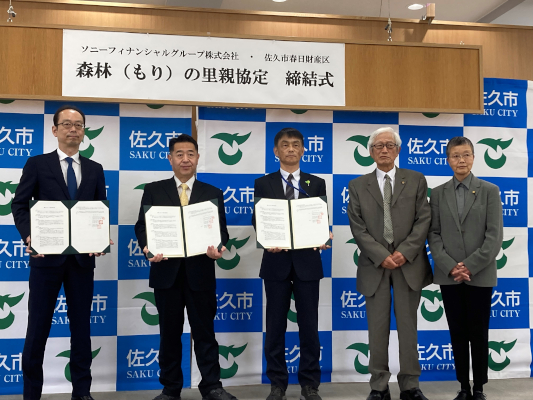
On May 27, 2025, Sony Financial Group entered into a “Forest Foster Parent” agreement* with the Kasuga property district of the city of Saku, Nagano Prefecture (Administrator: Seiji Yanagida, mayor of Saku).
Sony Financial Group promotes a wide range of environmental conservation initiatives across the areas of climate change, biodiversity, and resource use through its businesses, with the aim of passing on a beautiful planet to future generations. Starting with this collaboration with the Kasuga property district of the city of Saku, the Group will actively engage in conservation activities in rural and semi-natural landscapes.
* A Nagano Prefecture–facilitated program that enables collaboration between companies committed to social contribution and local communities seeking to engage in forest management and conservation activities.
Introduction of SynecocultureTM at Hibiya Park

Since 2024, Sony Bank has been working on the creation of flower beds at the Color Leaf Garden in Tokyo Metropolitan Hibiya Park (Chiyoda-ku, Tokyo), using Synecoculture—an open-field cultivation method that requires no tilling, fertilization, or pesticides. Employees regularly participate in the maintenance and observation of the garden, gaining hands-on learning opportunities by observing plant growth and studying the insects that gather in this environment. These activities provide opportunities to deepen understanding of biodiversity.
Support for NACS-J’s “Forests Where Golden Eagles Can Thrive” Initiative
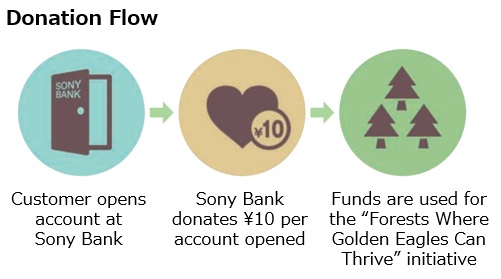
With the aim of achieving a nature-positive society, Sony Bank has launched a donation program to support the “Forests Where Golden Eagles Can Thrive” initiative, which focuses on forest conservation and the protection and restoration of biodiversity in Japan.
Under this program, Sony Bank donates ¥10 to the Nature Conservation Society of Japan (NACS-J) for each new account opened.
The golden eagle sits at the apex of the forest ecosystem pyramid and serves as an indicator of forest richness. However, its population has been declining in recent years due to the deterioration of its habitat. NACS-J promotes the “Forests Where Golden Eagles Can Thrive” initiative and engages in activities such as restoring degraded forests to biodiverse ecosystems and creating hunting grounds at key sites nationwide, including the town of Minakami in Gunma Prefecture and �the town of Minamisanriku in Miyagi Prefecture.
Donation of “Sora Bear Power Plants”
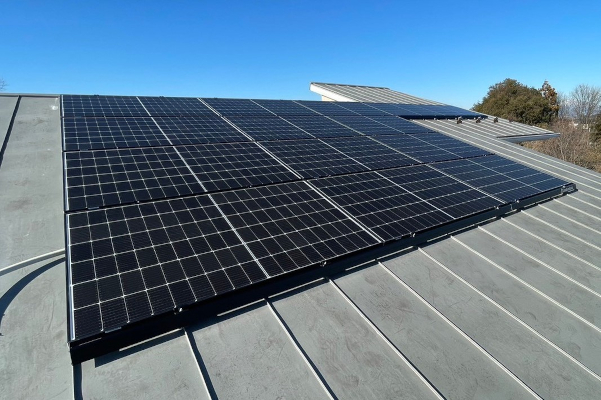
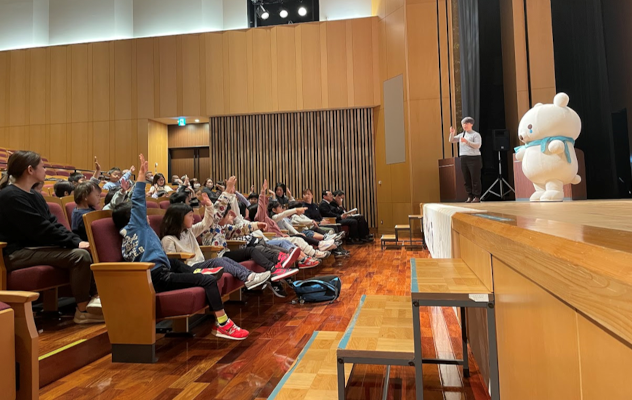
Sony Life and Sony Assurance donate solar power generation systems known as Sora Bear Power Plants to kindergartens, nursery schools, and certified childcare centers across Japan through contributions to the NPO Sora Bear Fund, which promotes renewable energy awareness and environmental education. Since July 2017, Sony Life has offered a web-based version of its Policy Guide and Policy Provisions in addition to the traditional printed version. Based on the number of customers who choose the web version, a portion of the resulting reductions in paper use and printing-related costs is donated. Sony Assurance confirms customers’ annual mileage when automobile insurance policies are purchased. If actual mileage is lower than initially estimated, Sony Assurance donates an amount determined based on the total distance not driven compared with the original estimate.
 |
 |
Solar panels donated to
Nishinomori Kodomoen (Gunma Prefecture) |
Commemorative donation ceremony held at
Yamaga Kodomoen (Kumamoto Prefecture) |
Reducing CO2 Emissions by Switching to Paperless Contract Procedures and Electronic Issuance of Documents
Sony Financial Group has been striving to conserve paper resources and cut down on CO2 emissions related to postal mailings by shifting to paperless documentation for certain contract procedures and transactions.
Sony Life has adopted paperless approach across the whole contract process from buying policies through undergoing post-contract procedures and filing insurance/benefit claims. The company has also created a special website on which customers can view pamphlets and other documents, thus significantly reducing CO2 emissions and use of paper associated with mailing of printed documentation. By adopting remote interviews and processes, Sony Life contributes to reducing employees’ transport-related CO2 emissions when visiting customers. In the office, the company has adopted electronic workflow software to reduce paper use by reducing paper-based document circulation and situations regarding signature seals.
Sony Assurance has made it possible to apply for automobile insurance policies, fire insurance policies, medical insurance policies and overseas travel insurance policies online, thereby avoiding the need for printing and mailing of insurance application forms and other documents. Also of note, Sony Assurance promotes reduction in the use of paper resources, exemplified by a “paperless insurance certificate discount” of up to ¥500 on automobile and fire insurance premiums when customers who buy a policy online opt not to have certificates of insurance and other documents printed and mailed.
As an Internet bank, Sony Bank promotes paperless transactions by principally providing information on web pages and using electronic document delivery for delivering transaction slips, passbooks, explanations of products and delivery of forms to customers. In addition, for procedures related to mortgage loans and card loans, Sony Bank provides a document upload system and works together with customers to reduce CO₂ emissions and the use of paper resources.